Animal Farm [George Orwell]


Animal Farm is barely a hundred pages long, yet it holds up a mirror to every society . Written in 1945, it still reads like a report on the world outside my window.
The book came to me as a suggestion from Manju Madam. I picked it up expecting a simple fable about talking animals. I put it down with the uneasy feeling that I had been reading about my own life.
On the surface it is a political satire. Underneath, it is a quiet study of how power slips away from the many and settles in the hands of a few, one small, reasonable-sounding step at a time. Unlike my other reviews I will start with details of the writer so that we will get a better idea about the book.
The man behind the pen
George Orwell was the pen name of Eric Arthur Blair. Surprisingly for many Indian readers, he was born in 1903 in Motihari, Bihar, where his father worked in the opium department of the British Indian government.

He was educated in England, then served five years in the Indian Imperial Police in Burma. What he saw there, the daily arrogance of empire, made him a lifelong enemy of any power that rules people without their consent.
In 1936 he went to Spain to fight against fascism in the Civil War and was shot through the throat. There he also watched Soviet-backed communists turn on their own leftist allies, jailing and silencing them. That betrayal shaped everything he wrote afterwards.
Orwell called himself a democratic socialist. He was not against the dream of equality; he was against those who used that dream as a ladder to climb to power. He went on to write Nineteen Eighty-Four in 1949 and died of tuberculosis in January 1950, only 46 years old.
The world in which the book was born
To understand Animal Farm, we have to stand where Orwell stood. In 1917, the Russian Revolution overthrew Tsar Nicholas II with the promise of a land where workers would own the fruits of their labour.
Within two decades that dream had turned into Joseph Stalin's dictatorship. Rivals like Leon Trotsky were driven out and later murdered. Millions died in forced farm collectivisation and famine, while show trials made old revolutionaries confess to crimes they never committed.
Orwell wrote the book between 1943 and 1944, in the middle of the Second World War. At that time Britain and the Soviet Union were allies against Hitler, and criticising Stalin was considered almost unpatriotic.
So publisher after publisher rejected it, including T. S. Eliot at Faber and Faber. It was finally published on 17 August 1945, just as the war ended, with the innocent subtitle A Fairy Story. Within a few years the Cold War began, and the world suddenly understood exactly what Orwell had been saying.
The story, without spoiling the magic
On Manor Farm, owned by the careless and often drunk Mr Jones, an old boar named Old Major gathers the animals one night. He tells them of a dream: a world where animals are free from humans and enjoy the full reward of their own work.
Old Major dies soon after, but his dream does not. The animals rise up, drive Mr Jones away, and rename their home Animal Farm. The pigs, being the cleverest, take charge of organising everything. Seven Commandments are painted on the barn wall, the last and greatest being that all animals are equal.
At first, life is hopeful. The harvest is the best ever, and everyone works with pride. But slowly, two pigs begin to compete for leadership: the inventive Snowball and the silent, scheming Napoleon. Using a pack of fierce dogs he has secretly raised, Napoleon chases Snowball off the farm and becomes the sole leader.
From there, the change is gradual and almost invisible. The pigs move into the farmhouse, sleep in beds, trade with humans and drink alcohol. Each time, the commandments on the wall are quietly altered, and the clever pig Squealer convinces everyone that it was always so. The loyal workhorse Boxer works himself to exhaustion, saying only that he will work harder and that Napoleon is always right.
In the end, the farm gets back its old name, Manor Farm. In the final scene, the animals look through a window at the pigs dining with human farmers, and they can no longer tell which is pig and which is man. The revolution has come full circle.
Who is who on the farm
Every animal stands for a real person or group in Soviet history. But the beauty is that each one also stands for someone we meet in our own offices, neighbourhoods and homes.
Character | In our everyday world |
Mr Jones | The old, careless master everyone wanted to remove |
Old Major | The idealist whose dream others later misuse |
Napoleon | The leader who speaks little and controls everything |
Snowball | The capable rival who becomes the convenient scapegoat |
Squealer | The spokesperson who can make black look white |
The dogs | The enforcers who keep everyone afraid to speak |
Boxer | The honest worker who trusts blindly and gives everything |
The sheep | The crowd that shouts slogans to drown out debate |
Benjamin the donkey | The one who sees the truth but chooses to stay quiet |
Moses the raven | The voice promising a reward in a life after this one |
Frederick and Pilkington | Outside powers who deal with the leader, not the people |
Why a 1945 book still feels like today's news
What amazed me most is not the history but the method. The journey from Animal Farm back to Manor Farm happens without a single dramatic moment where anyone says, "Now we will be tyrants." It happens through tiny edits, small privileges and patient explanations.
That is exactly how power moves in real life. It flows quietly from the common man to a small group that holds either authority or money. Read any line of this book slowly and you will find a scene from our own society behind it.
The most famous line in the book captures it all, when the commandment on the barn wall is finally rewritten: "All animals are equal, but some animals are more equal than others." Every one of us has felt that sentence at some point, in an office, a queue or a meeting room.
Not only politics: organisations, societies, even families
I believe the book does not rest only on the games of politics. Many organisations, communities and even families are gradually shaped by the very methods Napoleon uses.
Rewriting the rules quietly. A policy changes, and soon nobody remembers it was ever different.
A Squealer for every system. There is always someone ready to explain why the unfair thing is actually for our own good.
Slogans instead of thinking. Like the sheep bleating "Four legs good, two legs bad," repeated phrases replace real discussion.
A Snowball to blame. Whenever something fails, an absent person or an outside enemy is held responsible.
The Boxer mindset. The honest worker who says "I will work harder" is admired, used and finally discarded.
The invisible chains
Many times I feel that we are trapped in a system that our society or organisation has placed around us. It discourages us from thinking openly. Any resistance automatically makes you a traitor, a rebel or "not a team player." You are not supposed to question the logic or the science behind the rules, and you cannot act on your own interests.
The philosopher Jean-Jacques Rousseau put it unforgettably in 1762: "Man is born free, and everywhere he is in chains." Our own poets and thinkers have expressed the same truth in their own words: man is always chained by his society. Animal Farm shows us how those chains are forged, link by link, often with our own willing hands.
Imagine if a person were set free to think without boundaries already drawn by society, or by emotions manufactured by fellow human beings. The thought process and creativity of humankind would reach an entirely different horizon. True freedom begins the day our thoughts are free from influences falsely created for someone else's benefit.
My favourite line: the hen and her five eggs
One small moment made me laugh and then think for days. A hen proudly announces that, under the guidance of Comrade Napoleon, she has laid five eggs in six days.
A pig is being credited with guiding a hen to lay eggs. The hen did all the work; the leader takes the glory, and the hen herself is made to thank him for it.
We have built a culture just like this. By creating a position through money or rank, one can automatically claim the benefits of other people's efforts. Often our lives, which only we truly understand, are "guided" by someone living in an entirely different world.
I feel this idea is applied around us far more often than even the theory of evolution. The flow of money, the flow of power, equality, democracy and opportunity are all quietly influenced by this kind of "Animalism."
Should you read it?
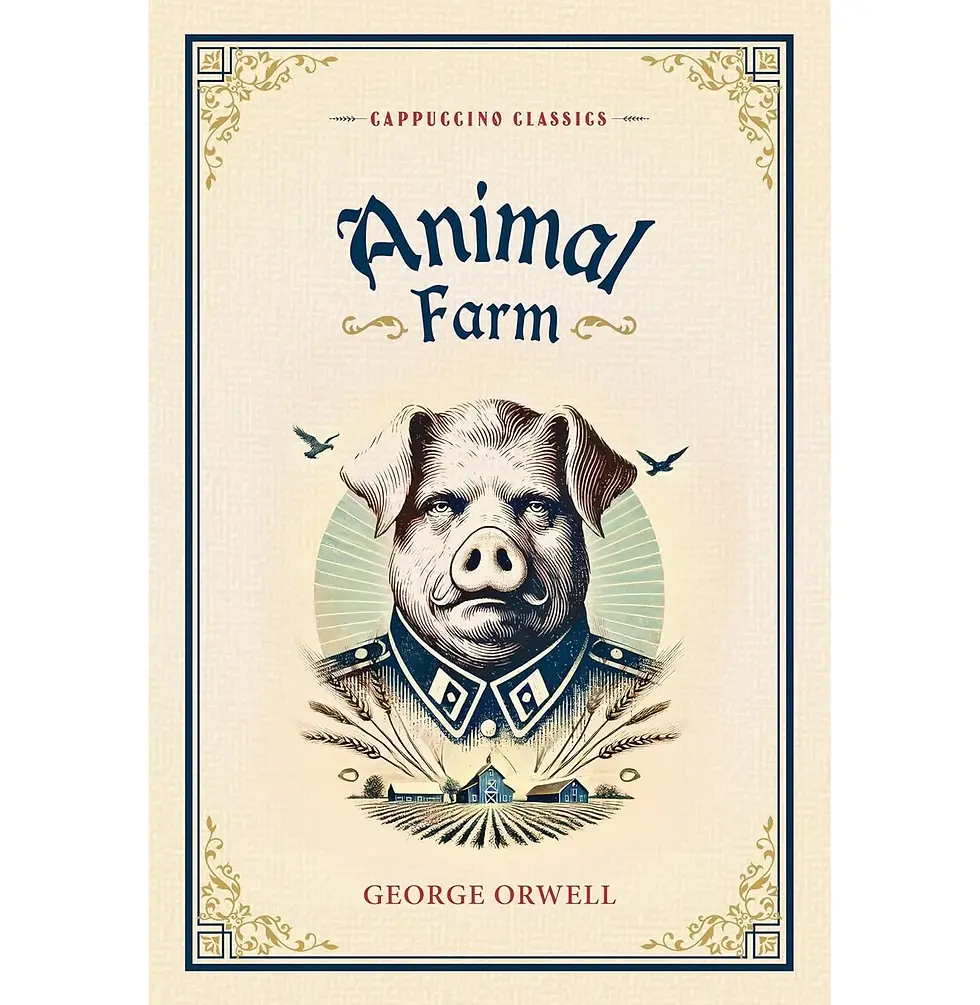
Animal Farm is a must-read for anyone who loves political satire. I also recommend it to those who like to look back at history and understand how nationalism, patriotism and democracy can work very differently from what their words promise.
It is short enough to finish in one evening and deep enough to stay with you for years. The language is simple, almost like a children's story, which is precisely why its message cuts so deep.
Read it once for the story. Read it again for the history. Then read it a third time, and you may start recognising the pigs, the sheep, the dogs, and perhaps even a little of Boxer, in yourself.
My sincere thanks to Manju Madam for putting this gem in my hands.
My rating: 5 / 5
Will Read tho book